


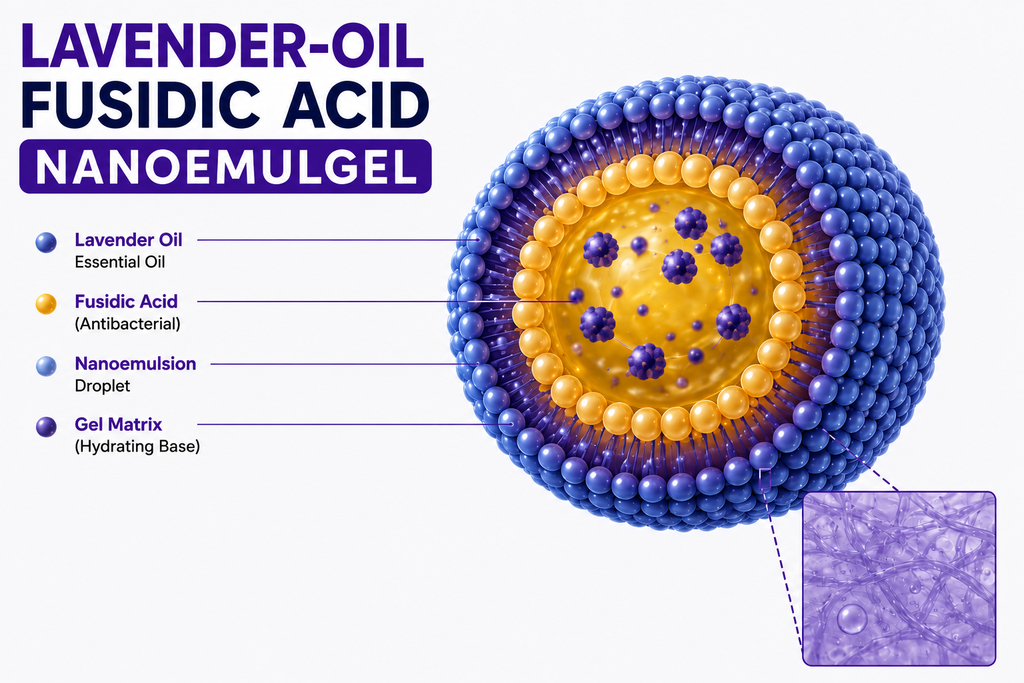
In the paper, “Lavender-Oil Fusidic Acid Nanoemulgel: A Novel Strategy Against Fusidic Acid-Resistant Staphylococcus aureus,” researchers explored a novel way to formulate an antimicrobial nanoemulgel that is superior to current available commercial market products for the topical delivery of Fusidic Acid.
A Fusidic Acid (FA) nanoemulgel was successfully developed using a self-nanoemulsifying technique that combined lavender oil, Tween 80, and Span 80, followed by incorporation into a Carbopol hydrogel. This approach enhanced FA’s antibacterial effectiveness by encapsulating it within the lavender oil nanoemulgel. Lavender oil was found to significantly improve the solubility of FA, and its combination with FA enhanced antimicrobial activity.
Key formulation parameters included particle size, polydispersity index (PDI), and zeta potential (measured with the NanoBrook Omni, Brookhaven Instruments, Nashua, NH) which all contributed to the formulation’s stability.
The resulting nanoemulgel demonstrated superior broad-spectrum antimicrobial activity, including effective action against Fusidic acid-resistant S. aureus, outperforming commercial products.
The study provides valuable insights into the application of straightforward nanotechnology techniques in the development of pharmaceutical dosage forms to treat skin infections.
# # #
Brookhaven Instruments, with a legacy of pioneering in light scattering and zeta potential analysis, is committed to advancing its technology to provide reliable and innovative solutions that support modern scientific breakthroughs in nanotechnology, pharmaceuticals, and materials science. We have dedicated support resources to help you along the way. We are real people helping real people in real-time.TM Our instruments have always been built in the USA.
Contact us today to learn more about our light scattering solutions for nano particle sizing and characterization via dynamic light scattering and zeta potential analysis.