The NanoBrook Series particle/molecule size and zeta potential analyzers incorporate all you need for fast, routine, sub-micron measurements of size and zeta potential. The instrument incorporates the principles of Dynamic Light Scattering (DLS) for particle sizing and distribution and Doppler Velocimetry (Electrophoretic Light Scattering, or ELS) for zeta potential measurement. The instrument also includes Phase Analysis Light Scattering (PALS) measurements for samples with low mobilities.
Rapid
Most measurements only take a minute or two.
Three Possible Scattering Angles
Measurements of colloids are traditionally made using a 90° scattering angle. For smaller nanoparticles, proteins including IgG, mAbs, and peptides, these < 50 nm samples can be measured using the backscattering angle (173°). Finally, the 15° detection angle can be selected for added sensitivity with aggregation measurements. Zeta potential measurements are always performed using the 15° detection angle to minimize diffusion broadening.
The NanoBrook Omni combines all of the most common configurations
With the NanoBrook Omni, measure samples in nearly every possible suspension environment from high salts such as PBS and sea water to organic solvents and aqueous solutions. Particle and protein sizing, with the highest sensitivity, utilize three measurement angles for truly unbiased measurement results.
Click the button to view the options available to buy online.
Introducing NanoBrook's DLSC Features
The new Dynamic Light Scattering Concentration (DLSC) Tool can be used to estimate the concentration of nanoparticles, colloids, or macromolecules in dilute solutions. By following a simple process of reference concentrations and the power of our advanced autocorrelator, this technique provides a rapid, non-destructive estimate of particle concentration.
Options available to Buy Online!
Place your order now through our secure online shopping system. We appreciate your business!
Characterizing proteins, nanoparticles, and polymers confronts the user with a difficult choice of instrumentation. Brookhaven Instruments makes that choice easier with the NanoBrook series of instruments. Choose from particle sizing including backscatter for proteins, Zeta Potential, or combinations including molecular weight determination of small polymers and proteins.
Measurement Principles
Principles of Operation – Sizing
Dilute suspensions, on the order of 0.0001 to 1.0% v/v are prepared, using suitable wetting and/or dispersing agents, if required. A small ultrasonicator is sometimes useful in breaking up loosely held agglomerates. At 173° sample volume may be reduced to 50 µL with a polystyrene, U-shaped, disposable cuvette and the sample is recoverable. At 90° square polystyrene or glass cells (two or three mL) are used, one as small as 10 µL (non-disposable). In addition, disposable, glass round cells with reusable Teflon stoppers are used for aggressive solvent suspensions. In all cases, just a few minutes are required for the sample and cell to equilibrate with the actively controlled temperature environment inside the NanoBrook.
Data Presentation
Figure 1
The NanoBrook particle size and zeta potential analyzer offer three choices. For routine determinations, an average diameter (Eff. Dia.) and a measure of the distribution width (Polydispersity) are sufficient for many applications. This is illustrated above in Figure 1 for the latex with a narrow size distribution. The second choice is to fit these values to a lognormal distribution, allowing the user to visualize the size distribution and to interpolate cumulative and differential results at 5% intervals.
Figure 2: Results from Test Bimodal Sample on NanoBrook Omni (diameters, in nm)
Figure 2 above shows an example of the third choice, suitable for more complicated, multimodal size distributions. Here, a numerical algorithm, including Mie theory, is used. These results are for a mixture of known latex particles. Positions of the measured particle sizes on the accompanying graph are in excellent agreement with the known sizes of 92 and 269 nm. During a measurement, the display can be switched interactively between any one of these — correlation function, lognormal, or multimodal — each shown “live” as data are accumulated. The live display is particularly useful in determining the end-point of a measurement where multimodal distribution shape may be important
Phase Analysis Light Scattering
For measurements of very low mobilities, the Brookhaven NanoBrook is the answer; the only answer! With concepts developed at Bristol University and Brookhaven Instruments, the NanoBrook determines zeta potential using phase analysis light scattering: A technique that is up to 1,000 times more sensitive than traditional light scattering methods based on the shifted frequency spectrum. Electrostatic repulsion of colloidal particles is often the key to understanding the stability of any dispersion. A simple, easy measurement of the electrophoretic mobility “even in nonpolar liquids” yields valuable information. Measurements made in water and other polar liquids are easy and fast with the NanoBrook. Such measurements cover the range of typically ± (6 to 100) mV, corresponding to mobilities of ± 0.5-8×10⁻⁸ m2 /Vs. The NanoBrook covers this full range, of course, and extends it by a factor of 1000 in sensitivity!
Principles of Operation – Zeta Potential
The NanoBrook utilizes phase analysis light scattering to determine the electrophoretic mobility of charged, colloidal suspensions. Unlike its cousin, Laser Doppler Velocimetry (LDV, [sometimes called Laser Doppler Electrophoresis, LDE]), the PALS technique does not require the application of large fields which may result in thermal problems or denaturation. This is because the measurement analyzes the phase shift. The particles need only to move a fraction of their diameter to yield good results. In salt concentrations up to 2 molar and with electric fields as small as 1 or 2 V/cm enough movement is induced to get excellent results. In addition, the Autotracking feature compensates for thermal drift.
Figure 3
Simple and clear presentation
Figure 3 above shows the results of an actual experiment with a NanoBrook instrument. The important parameters and results are seen at a glance. The excellent agreement of the five runs in this experiment is obvious as is the match of the experimental curve (red, bold) and its fitted version (red, thin). As with all Brookhaven instruments the user can simply produce a customized report.
Custom Columns
The software can be easily customized to display the columns needed for a quick review of the important parameters as shown below.
Comprehensive Information – ELS
The NanoBrook measures complete electrophoretic mobility distributions in seconds including multimodals. An example of a bimodal zeta potential sample can be seen on the result screen from analyzing a created mixture of charged particles. In Figure 4 below the results of analyzing a mixture of alpha and gamma Aluminas in 1 molar KCI at pH10 are displayed. The left peak is identified with the green cursor and shown to have a zeta potential of -20.54 mV. If the other peak is chosen the value given is -5.00 mV. The ability of the NanoBrook to provide this information distinguishes it from other methods which provide only an ensemble average.
Figure 4
Something more challenging – PALS
Of course, the NanoBrook can quickly and easily yield results from all “regular” samples but its real strength is in the difficult cases and to demonstrate the performance of this premium instrument where others fail, we offer the following table.
Multiple Sample Types
Table 1 below shows a variety of difficult-to-measure samples, all of which were easily measured with the NanoBrook. Some were measured in high salt concentration; some in low dielectric constant non-polar solvents; and some in a viscous liquid.
Electrophoretic Mobilities Determined with the NanoBrook Omni (units 10-8 m2 /V·s)
Sample
PALS Result
Lit. Value
Comments
NIST 1980
2.51 ± 0.11
2.53 ± 0.12
Electrophoretic mobility standard.
Blood Cells
-1.081 ± 0.015
-1.08 ± 0.02
Dispersed in physiological saline
Fe2O3
0.013 ± 0.0015
N.A.
Dispersed in dodecane
TiO2
0.255 ± 0.010
N.A.
Dispersed in toluene – not dried
TiO2
0.155 ± 0.011
N.A.
Dispersed in toluene-dried
TiO2
-0.503 ± 0.0015
N.A.
Dispersed in ethanol
Casein
-0.025 ± 0.002
N.A.
Dispersed in PEG – viscous
SiO2
-0.73 ± 0.04
N.A.
Dispersed in 2.0 M KCl – High salt
Biological samples such as proteins, antibodies, peptides, and DNA/RNA are easily denatured by electrical fields. Brookhaven’s NanoBrook can successfully measure the mobility of biological samples with typical voltages from 2 to 4 Volts. In Figure 3 above, Lysozyme was measured with 2.5 volts applied. Aggressive solvents such as DMF, THF, DMSO, MEK, etc., are easily accommodated by the Brookhaven NanoBrook system with the use of our special solvent-resistant electrodes and glass sample cells. The extension of zeta potential measurements in the realm of such systems is just another standout property of the Brookhaven NanoBrook. Usual solvent? If your solvent is unusual then its dielectric constant is probably unknown. In this case, our BI-870 Dielectric Constant Meter will quickly and accurately provide the information necessary for a zeta potential measurement.
Surface Zeta Potential – Principles of Operation
The Surface Zeta Potential feature allows the user to measure the electrical charge on materials like coated glass, plastic, tape, or other flexible surfaces. A series of measurements are taken on probe particles at different distances from a surface and the Surface Zeta Potential is calculated as shown:
μRhe
Simple fluids like water (low viscosity), and glycerin (high viscosity) are Newtonian and exhibit viscosity effects, the dissipation of energy when particles move in such fluids. But dissolve macromolecules in these liquids –synthetic or biopolymers—and networks can form. In addition to viscosity effects, there are now elasticity effects, the storage of energy when embedded particles move. By following the mean square displacement (MSD) of tracer (probe) particles in such fluid and microrheological properties such as η*, the complex viscosity, G″, the viscous loss modulus, and G′, the elastic storage modulus, can be determined as a function of frequency. Measurement of the autocorrelation function (ACF) using DLS techniques yields the MSD of tracer particles, which, under the right conditions, can be used to determine η*, G″, and G′ over a range of frequencies much higher than mechanical rheometers can attain. Much smaller sample volumes, in the microliters, are possible compared to mechanical instruments. Finally, since strains result from the thermally driven motion of tracer particles, these much smaller strains allow the study of fragile samples. The study of viscoelasticity in aggregating dilute protein solutions is a prime example of the benefits of DLS microrheology.
Surface Zeta Potential electrode assembly for aqueous systems
Note: Current users of the 90Plus PALS may upgrade to include backscatter provided their instrument has the necessary mechanics, optics, and hardware. Contact us for more information.
Speak To An Expert Today About Our Analytical Services
We’re standing by to help you select the right services for your characterization needs.
This website uses cookies to give you the very best experience. By continuing to browse this website you are agreeing to our use of cookies. To find out more how we use cookies, please review our Privacy Notice Accept and Close
Privacy & Cookies Policy
Privacy Overview
This website uses cookies to improve your experience while you navigate through the website. Out of these cookies, the cookies that are categorized as necessary are stored on your browser as they are as essential for the working of basic functionalities of the website. We also use third-party cookies that help us analyze and understand how you use this website. These cookies will be stored in your browser only with your consent. You also have the option to opt-out of these cookies. But opting out of some of these cookies may have an effect on your browsing experience.
Necessary cookies are absolutely essential for the website to function properly. This category only includes cookies that ensures basic functionalities and security features of the website. These cookies do not store any personal information.


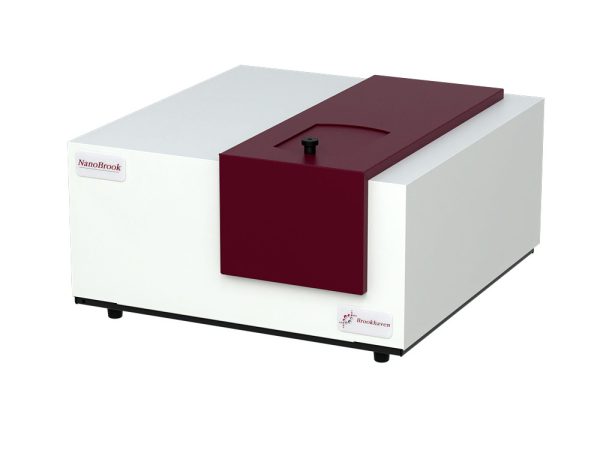

 Figure 1
 Figure 2: Results from Test Bimodal Sample on NanoBrook Omni (diameters, in nm)
 Figure 3

 Figure 4

 NanoBrook Series Brochure